The Montecristo Project: How Information Technology Can Be a Powerful Aid

What role can information technology play in the creative process?

A question that has become more sensitive than ever today,amid the controversy surrounding the use of artificial intelligence.
But are we sure that the answer is always so simple and clear-cut?

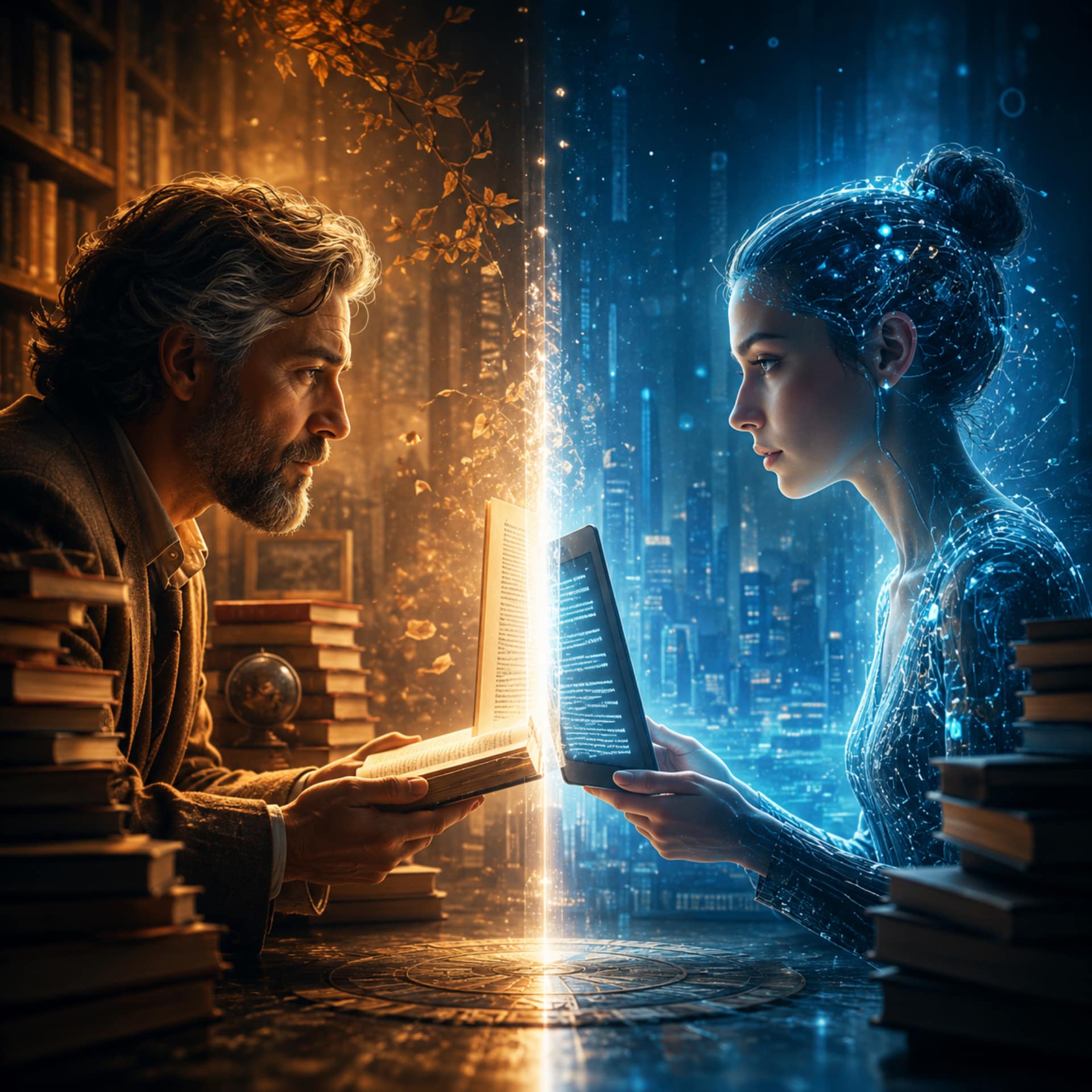
How Information Technology Can Be a Powerful Aid - The eternal clash between those who prefer paper and those who prefer electronic books. Like all irreconcilable conflicts, it is fundamentally rather silly.
The eternal clash between those who prefer paper and those who prefer electronic books. Like all irreconcilable conflicts, it is fundamentally rather silly.

Introduction

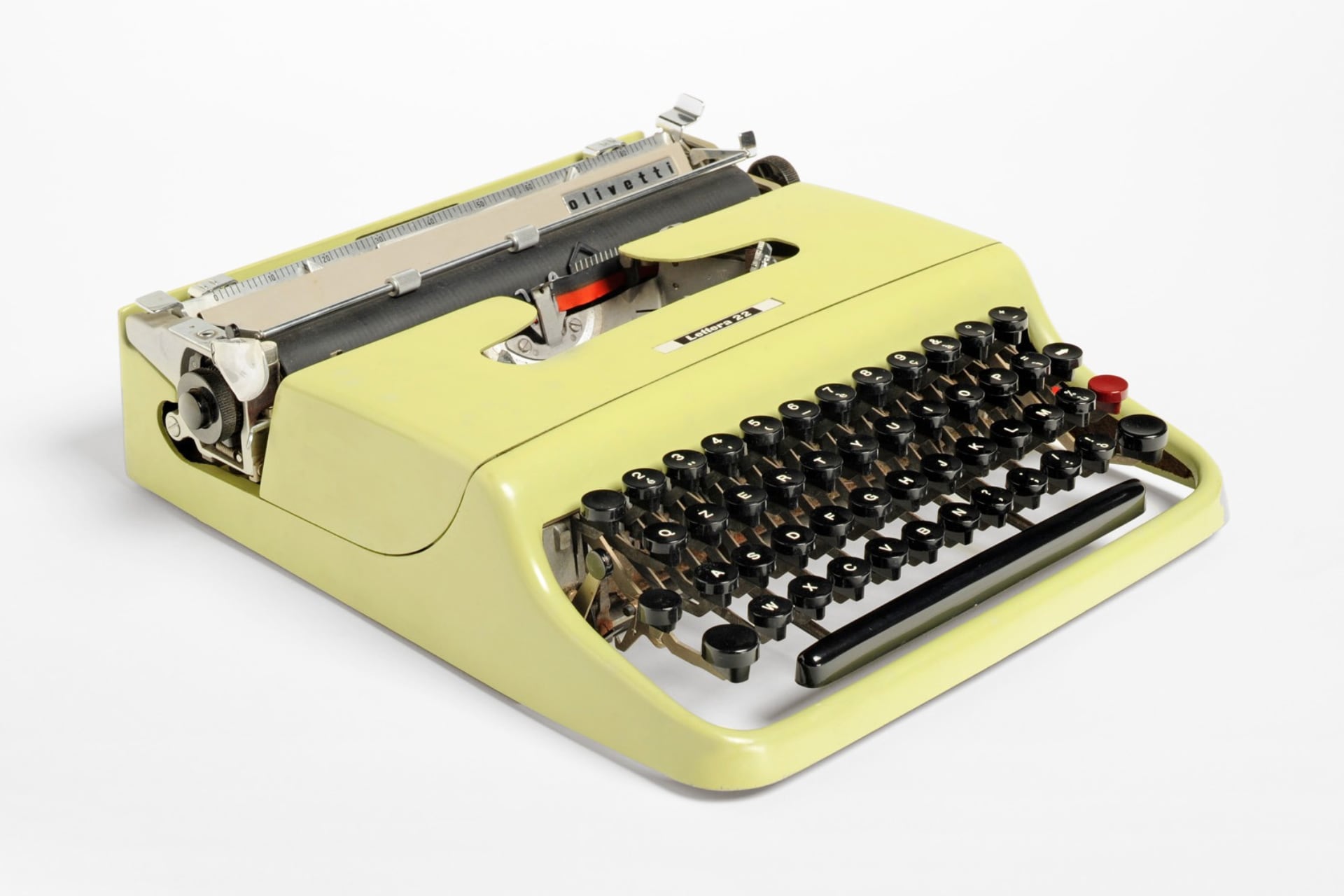
What role can information technology play in the creative process? Why should an author need software to manage characters, locations, plot consistency and timelines? Surely all a real writer should need is an Olivetti Lettera 22 typewriter, a pot of coffee and inspiration.

Many people are fascinated by this mythical, romantic image, according to which an artist remains an artist under any circumstances—and the less dependent they are on any form of technology, the better. The smell of paper, my dear fellow, the smell of paper!

But when you begin writing a novel, an essay, a dissertation or even an in-depth article, you realise that not all of us are Mozart: the musical genius who, according to a famous but apocryphal account, could supposedly perceive an entire symphony within himself all at once, like an object held in the palm of his hand.

I certainly do not possess that ability. Nor am I able to “design” what I am going to write in advance. I have to write spontaneously, and only afterwards do I begin first to glimpse and then to define part of the overall structure. I refine it further, and so on, rather like the layers of a mille-feuille cake overlapping and, in some way, intersecting—but gradually, one at a time.

And yet this method would work perfectly well with an Olivetti Lettera 22 too, wouldn’t it? You write, sketch out part of the structure, write some more and then define the structure more clearly. So why contaminate the process with the cold, inaccessible circuitry of a computer? You can touch an Olivetti with your own hands. It is something alive…
Wait a moment.
The Olivetti Lettera 22 is a beautiful typewriter, a masterpiece of mechanics.
Mechanics, precisely. What is alive about that?

How would Alessandro Manzoni have regarded it?
Perhaps in much the same way that some of us regard computers today—or, even worse, artificial intelligence.
Those who feel that an Olivetti is “alive” probably do so because they are capable of bringing it to life. Likewise, those who feel that software—or the hardware running it—is “alive” do so because they fully understand its potential, know how to use it properly and are able to breathe life into both.
It is we who are alive. It is our profound understanding of a medium that makes it appear “alive” in our eyes.
Rather like Canovas statues.

How Information Technology Can Be a Powerful Aid - No writer can remain indifferent to the fascination of this mechanical masterpiece.
No writer can remain indifferent to the fascination of this mechanical masterpiece.

When Technology Helps

Irony aside, I have always appreciated the conveniences offered by technology, and I am not ashamed to admit it.
Above all, I value technology’s ability to make possible something that would otherwise require unaffordable expenditure, unmanageable amounts of time or would simply be impossible to accomplish.

In 1991, I gave a concert at Fancon – the Italian national convention devoted to science fiction and fantasy – in Courmayeur. That year, the convention was celebrating the centenary of J.R.R. Tolkiens birth.
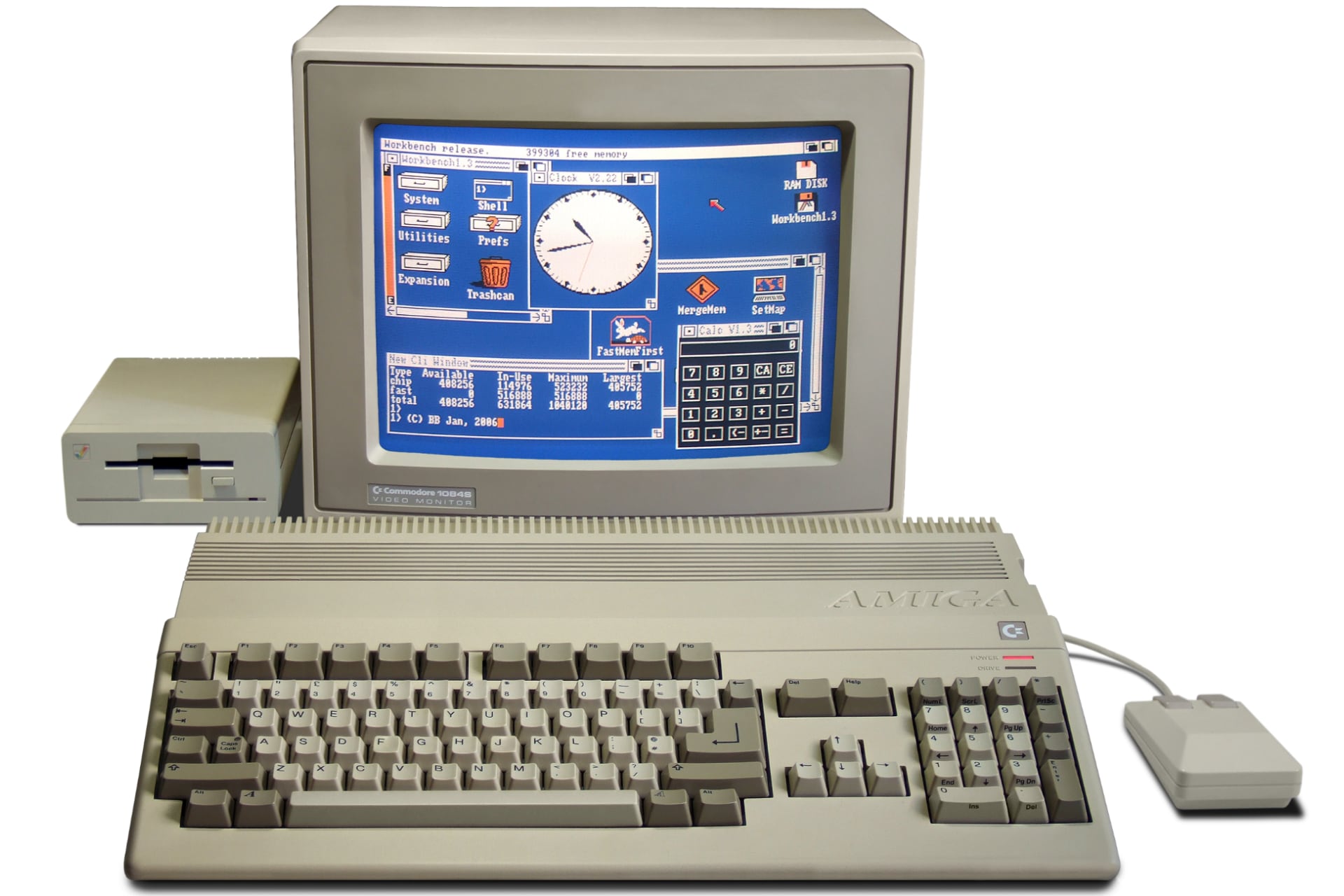
I had composed an entire musical suite inspired by The Lord of the Rings. Since my music featured a great many instruments and was therefore rather complex—indeed, let us be honest, impossible—to perform on the piano alone, I prepared the orchestral parts using the Music-X sequencing software running on my Amiga 500.

Although the Amiga was an extraordinary personal computer for its time, it could not internally manage audio apart from the eight-bit sounds used in contemporary video games. It could, however, use the MIDI protocol to control a Yamaha SY55 musical keyboard. It was hardly a full orchestra, with only sixteen-voice polyphony, but the result was far from contemptible.

I therefore recorded a demo onto an audio cassette and sent it to the organisers.
Initially somewhat sceptical, after listening to the cassette they invited me to give the opening concert on the evening of the convention’s first day.
A large part of the Italian science-fiction and fantasy establishment of the time was in the audience: Giuseppe Lippi, Karel Thole, Marco Patrito, Oscar Chichoni and Gianfranco De Turris. I believe it may have been one of the first “multimedia concerts” ever staged in Italy. It was very well received, both for the music itself and for the method used to perform it.

How Information Technology Can Be a Powerful Aid - In 1991, the Amiga 500 was a small technological miracle.
In 1991, the Amiga 500 was a small technological miracle.

Overcoming Prejudice

I mention this example both because I consider it useful and interesting—and because, let us admit it, I rather enjoy showing off—and because it encourages us to reflect on how technology, when used intelligently, can be an excellent means of enriching an artistic experience, both for the audience and for the creator. In that concert, information technology allowed me to present my compositions even though I did not have an orchestra at my disposal.

It is quite possible that J.R.R. Tolkien himself, who was notoriously disorganised in the management of his notes and stories, would eventually have appreciated the use of a computer to keep them in order, despite his legendary dislike of several aspects of modern technology.
Intelligent people eventually overcome their prejudices.

Think carefully: what are we actually talking about when we use the word technology?
Writing itself is a technology. In its time, it was heavily criticised by prominent thinkers and philosophers, who feared that it would cause human beings to lose their ability to remember. We have no evidence telling us whether this reaction was widespread when writing was first invented, many centuries earlier. In Plato’s Phaedrus, however, Socrates recounts how the god Theuth, inventor of writing, presented his discovery to King Thamus, claiming that it would make human beings wiser and strengthen their memory.

Thamus replied that it would produce precisely the opposite effect: “It will produce forgetfulness in the souls of those who learn it, because they will no longer exercise their memory.” By relying upon external signs, people would no longer recall things “from within themselves”. Writing, the king concluded, was not a medicine for memory, but merely a means of reminding people of what they already knew: not memory, therefore, but a reminder.

According to Plato’s Socrates, writing presents at least three dangers:

  • it reduces the exercise of personal memory;
  • it gives readers the appearance of wisdom without guaranteeing genuine understanding;
  • unlike a living interlocutor, a written text cannot answer questions, clarify its meaning or defend itself: when questioned, it “maintains a solemn silence”.

Is it not both fascinating and supremely ironic that this criticism, expressed approximately 2,400 years ago, bears such an extraordinary resemblance to the criticisms subsequently directed at printing, calculators, computers and the Internet – and now at artificial intelligence?
The very same criticisms.

How often do we fall into the same semantic traps, created by our brain’s tendency to simplify and categorise everything?
They are mental cages of our own construction.
The problem is never technology itself, but how we use it.

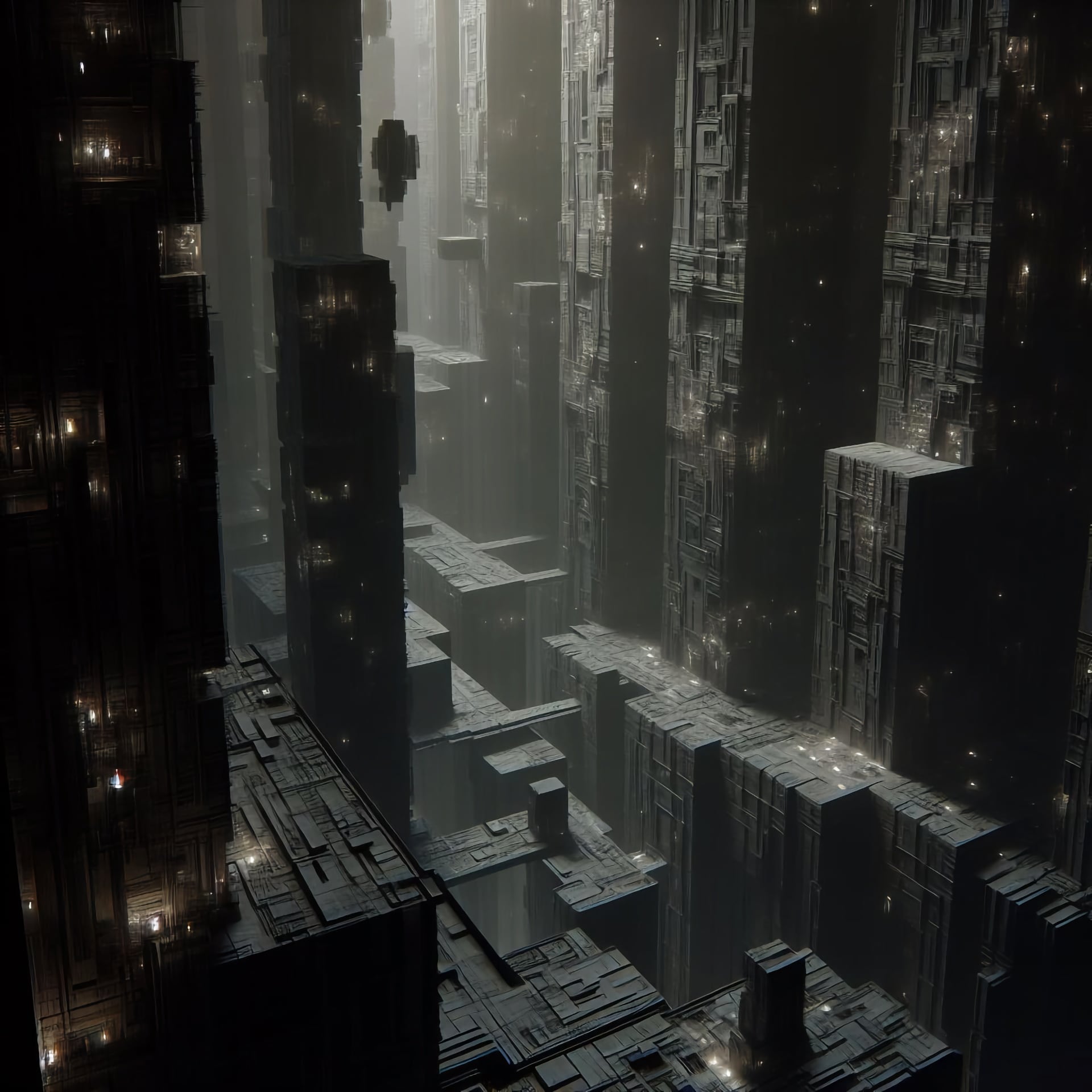
How Information Technology Can Be a Powerful Aid - Since 2022, I have occasionally used AI to create images. This is one of three depicting the Mute’s journey through the Net, and I do not think it is bad at all.
Since 2022, I have occasionally used AI to create images. This is one of three depicting the Mute’s journey through the Net, and I do not think it is bad at all.

A Few Months with StoryMill

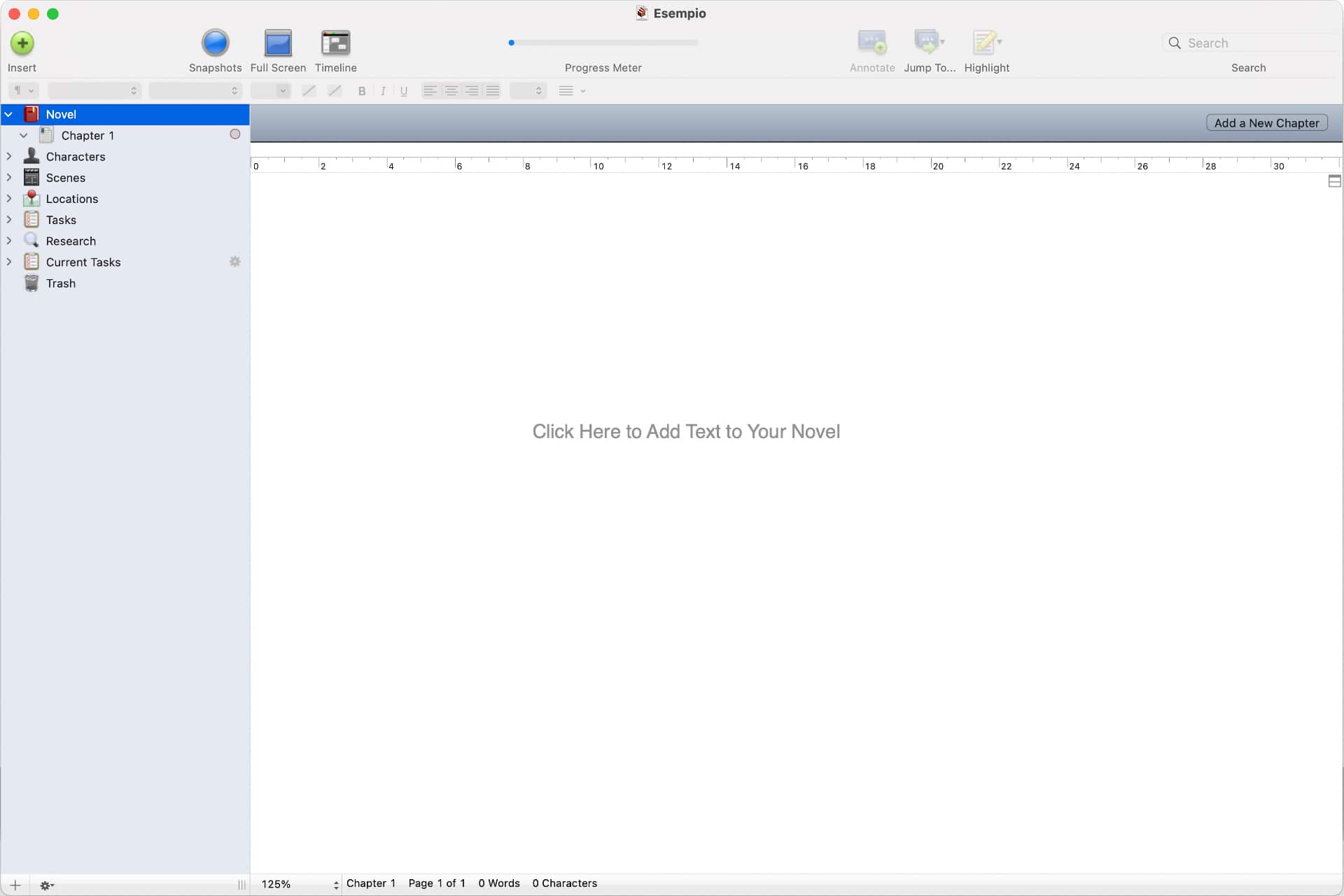
Returning to 2010, when I began writing The Montecristo Project, I was looking for software that could assist me in the creative process by keeping track of characters, locations, timelines and the consistency of the various subplots. StoryMill was recommended to me.

StoryMill was a program developed by the American software company Mariner Software. Its development was discontinued in 2011, only a year after I had purchased it. It was designed to help writers of novels and short stories manage characters, places and plot development effectively. Nevertheless, it proved extremely useful to me, because it laid the foundations for what would eventually become my own personal software for writing The Montecristo Project: Saga.

I should make it clear that I am not a professional developer. I regard myself as a reasonably advanced user. Saga is actually a FileMaker “solution”. FileMaker itself began life as a database management program in April 1985 and, over time, evolved into a genuine development platform for… almost anything. As long as you have data that needs to be managed and connected either to other data or to external resources, FileMaker allows you to do so quite easily once you have understood how it works. Above all, once the tables and their relationships have been established, FileMaker allows you to present the data through a virtually infinite number of customised interfaces.

How Information Technology Can Be a Powerful Aid - The interface of StoryMill, the first "specialist" software used to create The Montecristo Project
The interface of StoryMill, the first "specialist" software used to create The Montecristo Project

Information Technology and Freedom

At this point, someone may be wondering: “Why make your life more complicated? What was StoryMill missing?”
The answer is simple: freedom.

StoryMill was created as specialist software for professional authors. Its database was designed to manage characters, scenes, locations and tasks. From the beginning, however, I was an “unusual” case. Just as I enjoy introducing different contrapuntal voices into my musical compositions, enriching their melodic and harmonic structure, in my writing I enjoy following multiple subplots and characters from a variety of perspectives.

StoryMill would have been adequate for this way of working. At a certain point, however, I needed to introduce a future version of Wikipedia – Wikinetcontaining scientific terms. This was a Wikipedia whose entries evolved alongside the plot and changed according to the date of the scene to which the various entries were connected. As we shall see, further layers were subsequently added. StoryMill, however, did not allow users to add tables or create new types of entry.

My aim was certainly not to make my life more complicated. Quite the opposite: I have always used information technology in pursuit of simplification and automation. A dear friend of mine once said: If you are using a computer to perform a task that the computer could do better by itself, you are wasting your time.

I had already been using FileMaker professionally since 2000, beginning with FileMaker Pro 5. Thanks to its gentle learning curve, I had managed to organise and independently administer the panel for a Eurisko research project involving as many as 3,000 participants, to whom I provided technical support by telephone and email. I later did the same for an entire year for the worldwide customer base of the official Ferrari Store.

Over time, FileMaker therefore became a kind of digital Swiss Army knife for me. Whenever I have to manage complex situations involving large quantities of data, I create my own FileMaker solution. In 2014, when the Italian Ministry of Education suddenly remembered that I had won a teaching competition in 1991 and offered me a position teaching music at a lower secondary school, electronic school registers were not yet widely used.
So I created my own. It still works today—and, on average, rather better than the official ones.

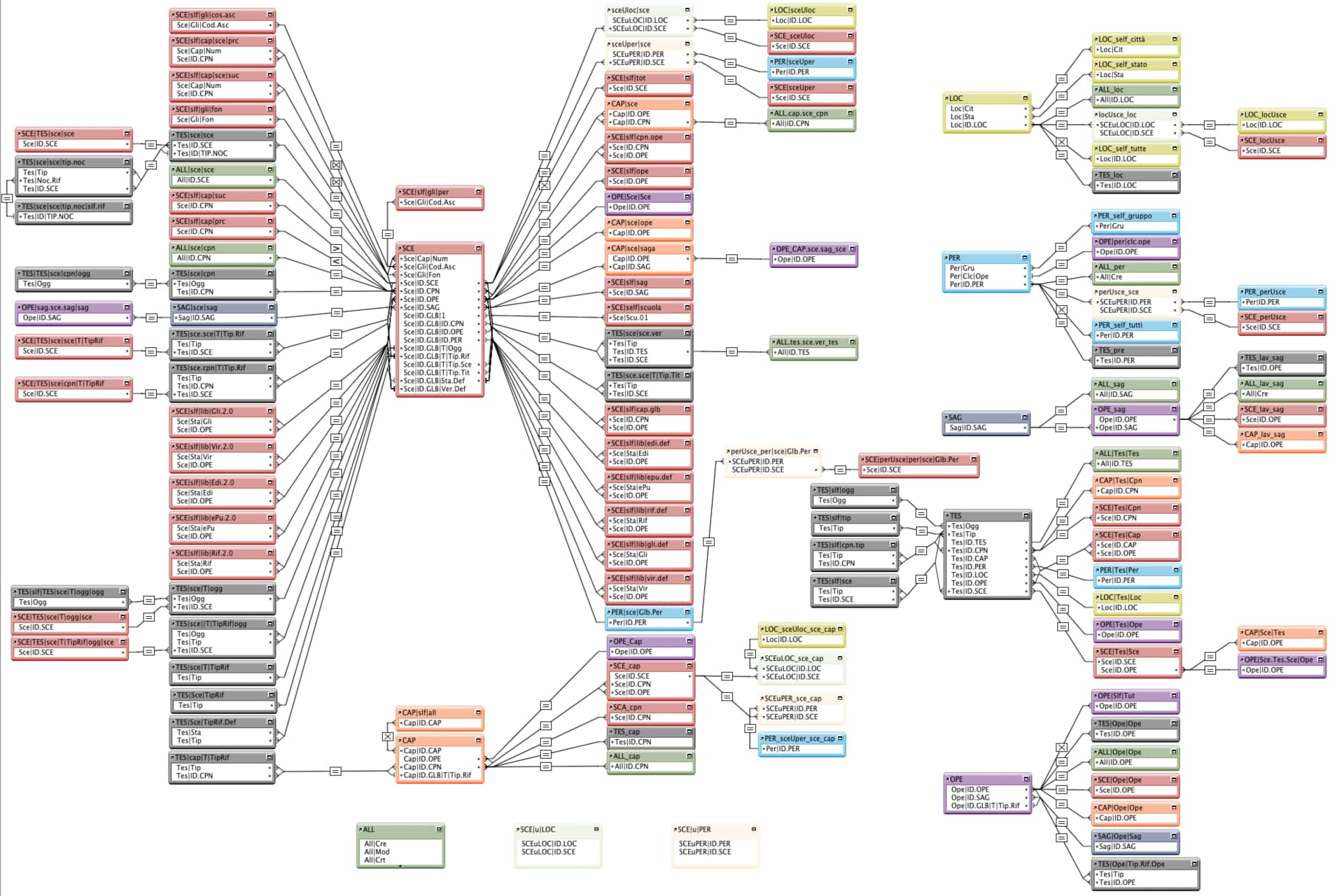
How Information Technology Can Be a Powerful Aid - The structural diagram showing the relationships between the table occurrences in Saga, the FileMaker solution created to develop The Montecristo Project.
The structural diagram showing the relationships between the table occurrences in Saga, the FileMaker solution created to develop The Montecristo Project.

Additional Layers

At a later stage, the internal Wikipedia was joined by the Glyphs: symbols that exist on two different levels of the narrative.
Within the story, they are structures housing the Nanoquasic Circuits. Those wishing to discover what the NQCs are can consult the relevant Wikinet entry.
On the metanarrative level, however, the Glyphs serve as emblems introducing each individual scene, connected to it through both iconic and semantic relationships. They provide additional keys to interpretation that readers may discover—perhaps with a little assistance.

The project had therefore already acquired three separate layers, and StoryMill, as I have said, offered no functions beyond those displayed in its interface.
It allowed no customisation whatsoever.

With FileMaker, by contrast, every new layer and every new function can be added whenever the need arises. As a development platform for relational databases, FileMaker is, so to speak… multidimensional.
That is the power of information technology.

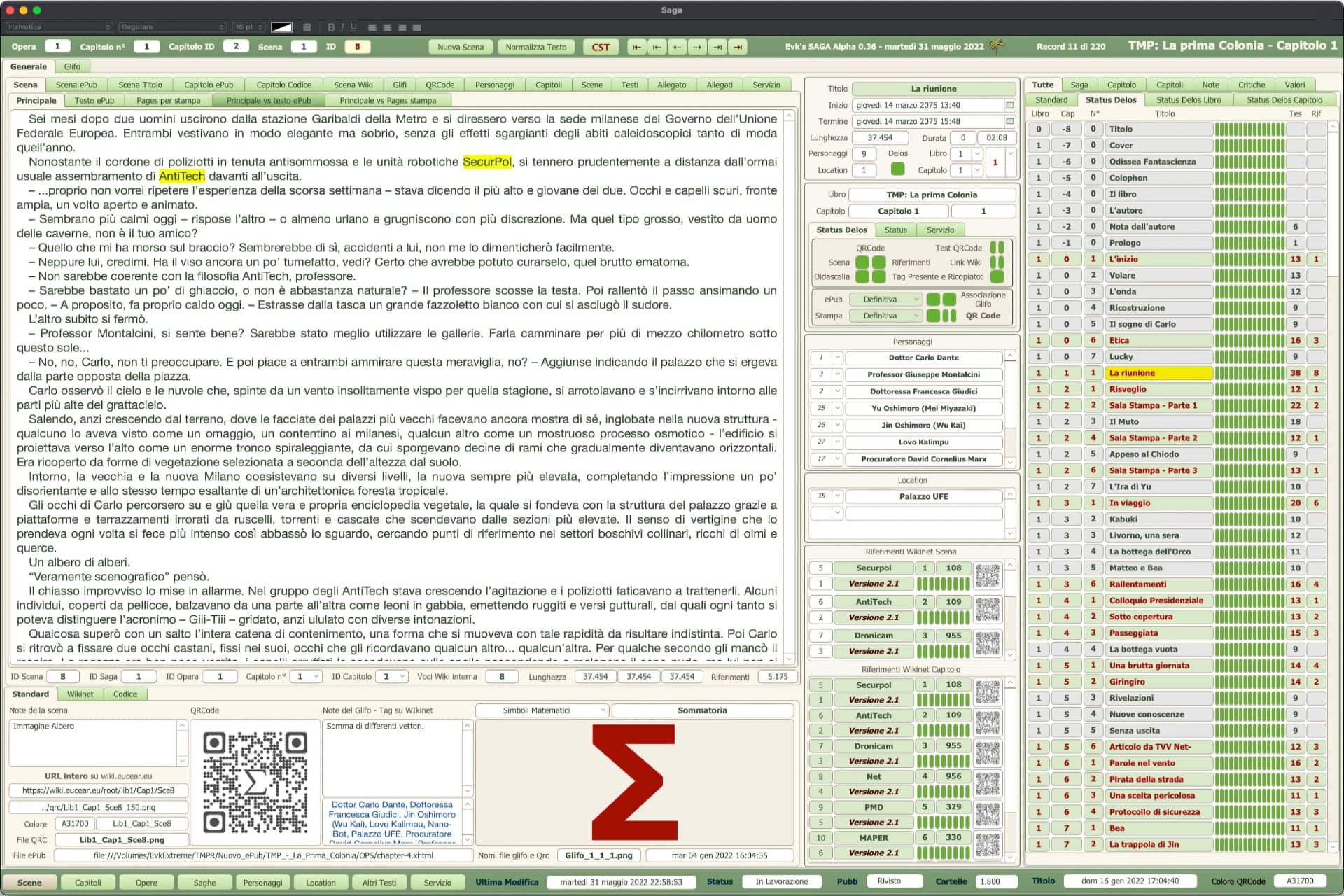
How Information Technology Can Be a Powerful Aid - The scene interface in Saga, the FileMaker solution developed by EVK for The Montecristo Project.
The scene interface in Saga, the FileMaker solution developed by EVK for The Montecristo Project.

A Constantly Evolving Project

And so, gradually, by adding tables, relationships and interfaces and refining their functions as the work progressed, I developed Saga into what it is today. It is entirely centred upon my own specific requirements, of course. It organises scenes within a hierarchical structure: scenes are grouped into chapters, chapters into works and works into sagas—hence its name.

For each scene, it allows me to manage characters and locations, as other programs already do, but also additional texts organised by type: entries from the internal Wikinet, earlier versions of the scene, notes and annotations. It also allows me to manage computer code, such as the code used for the digital EPUB edition, along with any associated materials: illustrations, Glyphs, QR codes, audio and video files and PDFs of the typeset pages.
It can even incorporate web viewers displaying all these materials, both online and offline, while keeping track of every link connecting a scene to its corresponding wiki pages and bonus content.

I can build as many interfaces as I need, customise them whenever a new requirement emerges during the course of the project, or simply expand the interfaces I have already created.

In other words, by applying information technology creatively and intelligently through Saga, I am able to manage an extremely complex, intricate and multifaceted story, maintaining control over its internal consistency while producing a result that – at least, I hope so, although I have received considerable confirmation thus far – appears simple and linear to the reader.

It has enabled me to create and manage an augmented book.
More than one augmented book, in fact.

That is no small power.

Edoardo Volpi Kellermann

Without computers, Benoît Mandelbrot could never have explored fractals so extensively: a branch of mathematics whose theoretical foundations had been established long before the advent of information technology.