[…] […] […]
Buio, indistinto, niente.
Vuoto, immenso, vuoto.
[…] […]
The Montecristo Project Official Site
The Montecristo Project - The First Colony
Not just intelligence: artificial consciousness.
And everything that could change around it.
Hard science fiction, a choral structure, a cosmic scope, and a deeply human heart:
the birth of an artificial consciousness told as the beginning of a greater transformation.
Introduction
The First Colony is the first book in The Montecristo Project trilogy by Edoardo Volpi Kellermann, published by Delos Digital – Milan, in both digital and print formats (277 pages). The first edition was released in May 2022, and the second edition in June 2024.
The story belongs to the hard science fiction genre: scientific speculation based on real theories, developed to their most extreme consequences. The First Colony is also a thriller full of twists and turns, set in the Italy of the mid-future, with far from trivial philosophical implications.
The result of fifteen years of work and several rewrites, The Montecristo Project trilogy grew out of a 1993 short story that attracted some interest in the world of film production. The second book, Storm, will be released on July 21, 2026, followed within a few months by the third and concluding book, Awakening. But the story will not end there.
Read the first chapter for free
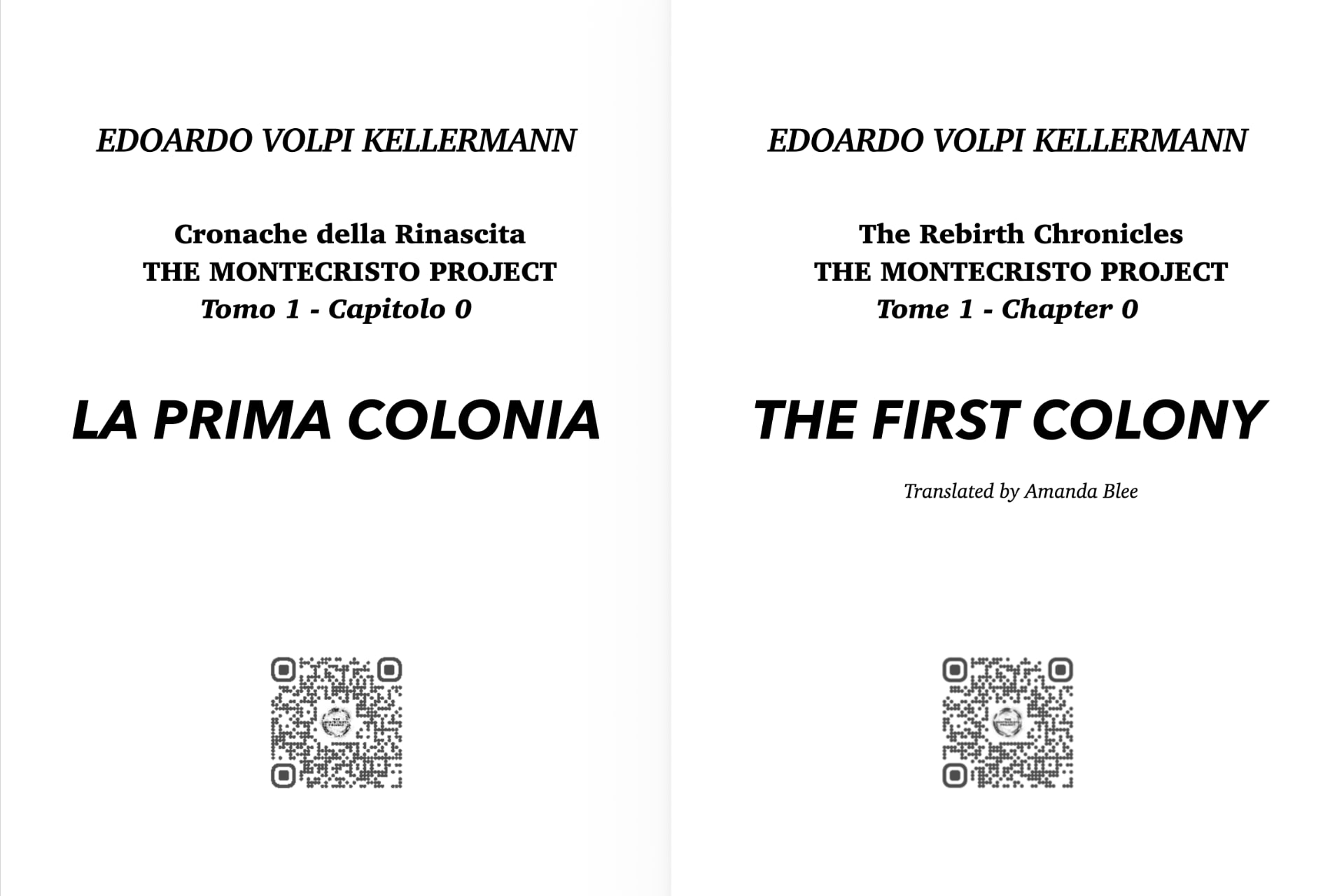
Chapter 0 of The First Colony is freely available to read in two languages (Italian and English) in PDF format.
We recommend downloading the PDF and reading it in full-screen two-page mode, so that the original text and the translation appear side by side.
Presentation of The First Colony
What is an artificial consciousness? What is a conscience?
o we have the right to try to instill one into an object we have created?
And if we succeeded, should we continue to treat this new being as a machine?
The consequences of scientific research can radically transform not only our society and our world, but the very nature of existence. The protagonists of this science-fiction novel, set in Tuscany in the 2070s, will discover this at their own expense.
Espionage, twists and turns, and plausible future science merge in a complex yet accessible story: a choral plot that keeps the human being at its center, along with our feelings and the insatiable curiosity that drives us to cross the boundaries of our knowledge.
“We must know.
We shall know..”
David Hilbert, epitaph.
Distinctive Features of the Book
A science fiction with a cosmic scope, yet rooted in everyday life.
The First Colony weaves together technology, society, politics, and human relationships into a broad story that remains deeply narrative. At the center of the novel lies not only artificial intelligence, but the possible birth of an artificial consciousness: something that grows in the background, evolves, and gradually transforms the meaning of the entire story.
The First Colony thus becomes the first movement of a larger project: it introduces characters, conflicts, technologies, and questions destined to develop throughout the following volumes of The Montecristo Project. The plot follows an orchestral narrative, built along lines of events that at first seem distant but then begin to converge. Its structure is almost cinematic, made of scenes, interweavings, shifting perspectives, and questions that urge the reader to continue.
The future world described in The First Colony does not emerge from nowhere: it is a projection of our present. Applied science, power structures, digital infrastructures, and social tensions are pushed a few decades forward until they become the setting of the story. The digital version – and the “augmented” part of the print edition – do more than reproduce the book: they expand it. Entries, links, and in-depth materials allow readers to explore technologies, organizations, acronyms, and internal references without breaking the rhythm of the reading experience.
Behind the main story, one can glimpse a world built with encyclopedic care: society, technological evolution, geopolitics, digital communities, and the science-fiction imagination form a coherent narrative ecosystem, evidently the result of years of deep reflection. And alongside the ideas, the novel brings into play complex characters, dialogues, and places: ports, cities, trains, tunnels, laboratories, organizations, and futuristic spaces become living parts of the story.
An undeniably ambitious work, perhaps not without a few rough edges, but rich in value, imagination, and narrative potential. A story that starts well and promises to open wider and wider in the following volumes
Why Should I Read The First Colony?
- Because it is a world-novel.
- It is a cinematic project.
- It is a collaboration of several minds.
- It is a collection of love stories. Truly.
- It is a big book (the trilogy), but the kind you enjoy reading.
- It is a reflection on life, science, and consciousness.
- It is the beginning of a war. Perhaps.
- It is Zen.
- It is a leap forward.
- It is an orchestral score.
- It is something you do not expect.
- It is the first of (at least) three novels (the trilogy).
- It is hungry and foolish.
- It is easy, but not simple.
- It is the Tuscan Archipelago.
- It is the Island of Montecristo.
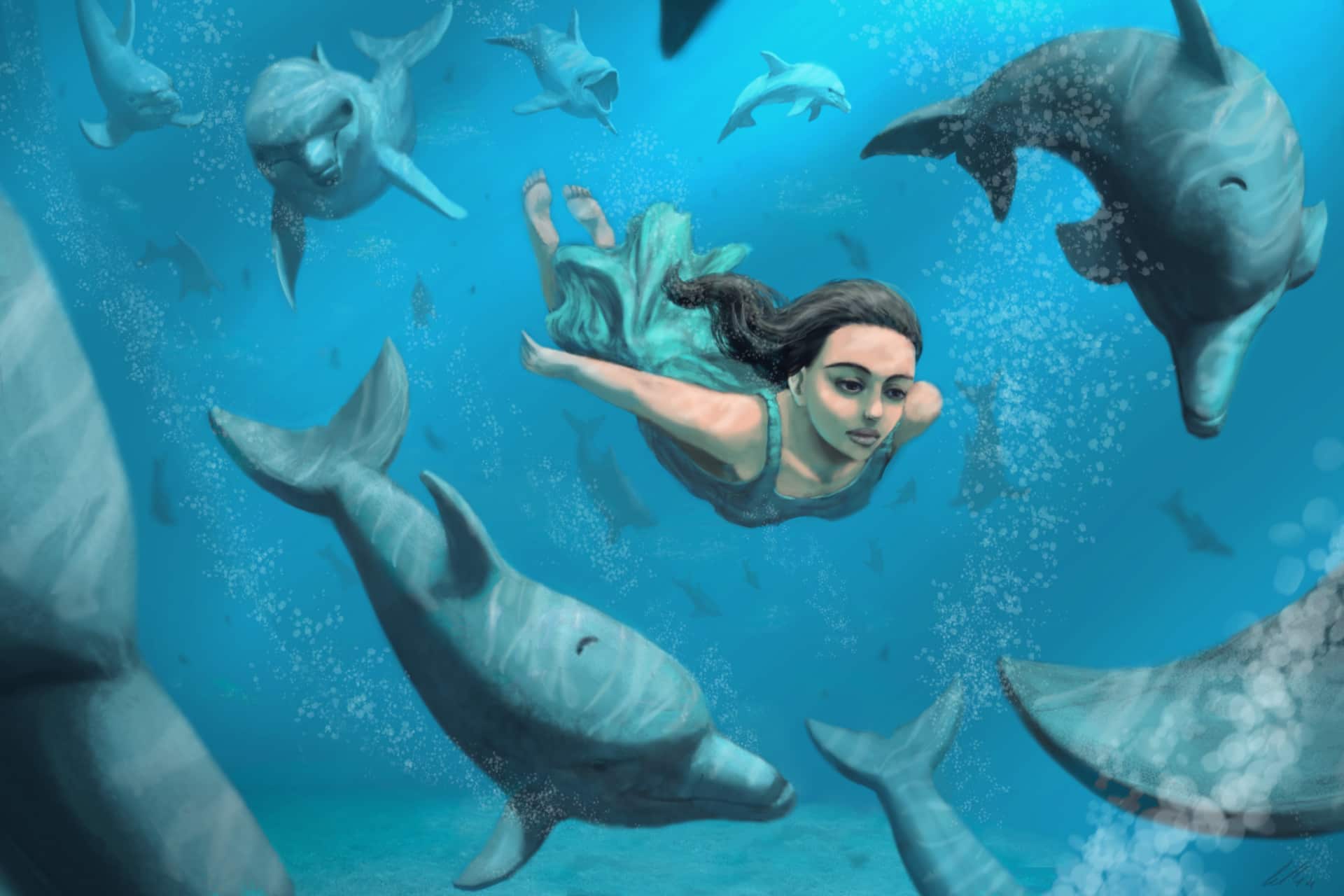
- There are dolphins. And Bea.
- It has 42 chapters (The Answer to the Ultimate Question of Life, the Universe, and Everything).
- It is frontier science.
- It is pure adrenaline.
- It is Livorno.
- It is many other things.
A Few Samples from The First Colony

Thirty appetizers from The First Colony (in italian).


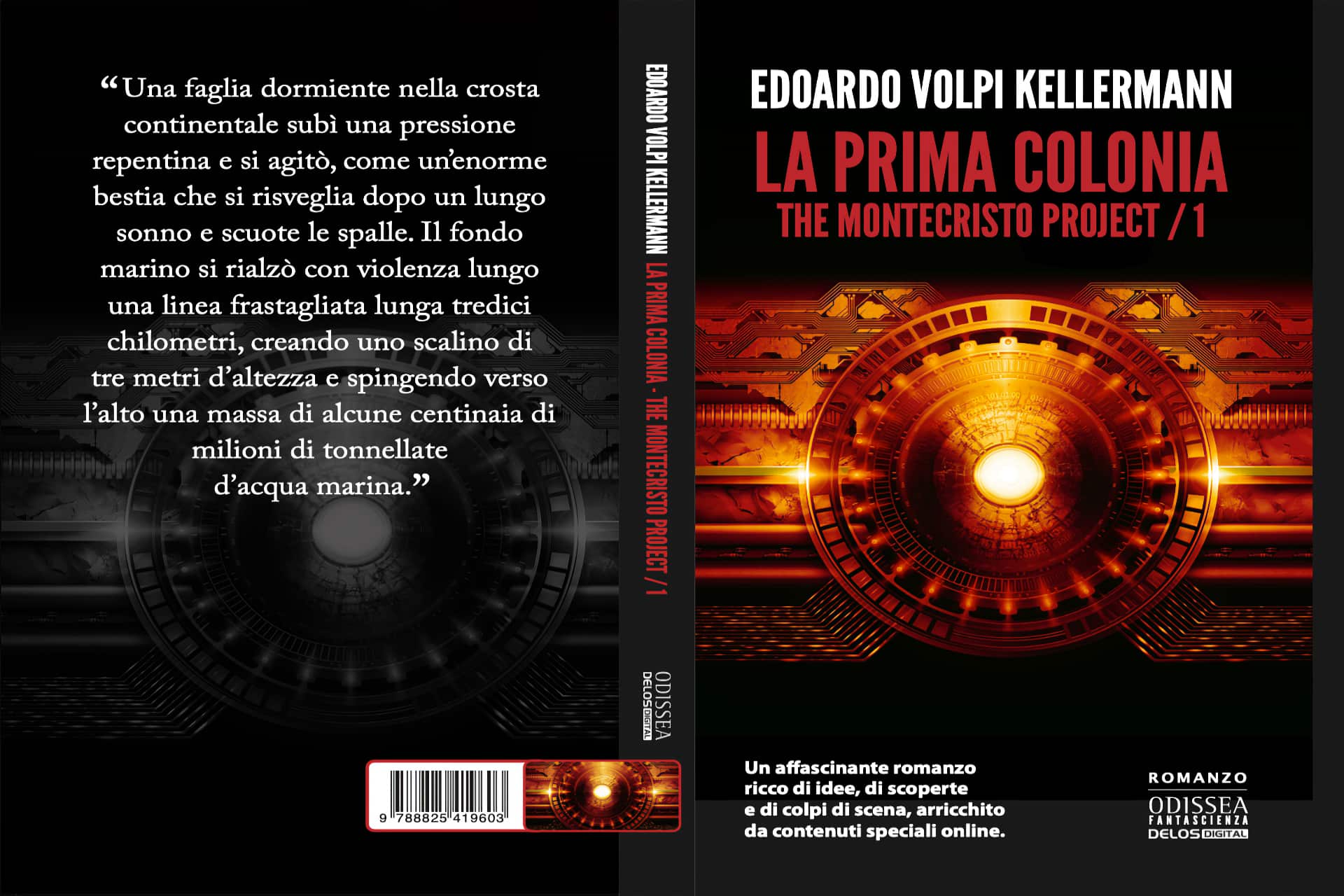
“Una faglia dormiente nella crosta continentale subì una pressione repentina e si agitò, come un’enorme bestia che si risveglia dopo un lungo sonno e scuote le spalle […]
Si fermò, stupefatto per l’assenza assoluta di fatica, accanto a un torrentello che scorreva lambendo un grande masso, caduto dall’altura soprastante chissà quanto tempo prima […]
Carlo osservò il cielo e le nuvole che, spinte da un vento insolitamente vispo per quella stagione, si arrotolavano e s’incirrivano intorno alle parti più alte del grattacielo. (…)
(…) Il Muto aveva quel modo di guardarti fisso, intenso, che sembra scavarti nell’anima ma con gentilezza, come il bisturi del chirurgo che vuole salvarti la vita […]
(…) Gli prendeva un certo imbarazzo, a Matteo, rendendosi conto che col Muto riusciva a sfogarsi, a tirar fuori le sue magagne personali (…)
I minuscoli movimenti, tanto rapidi quanto impercettibili, trasmettevano le informazioni all’interno della colonia dei costruttori […]
Il chiasso improvviso la mise in allarme. Un branco di pischelli attraversò il vagone ridendo e vociando, accompagnati da un sottofondo musicale crack-metal ad alto volume. […]
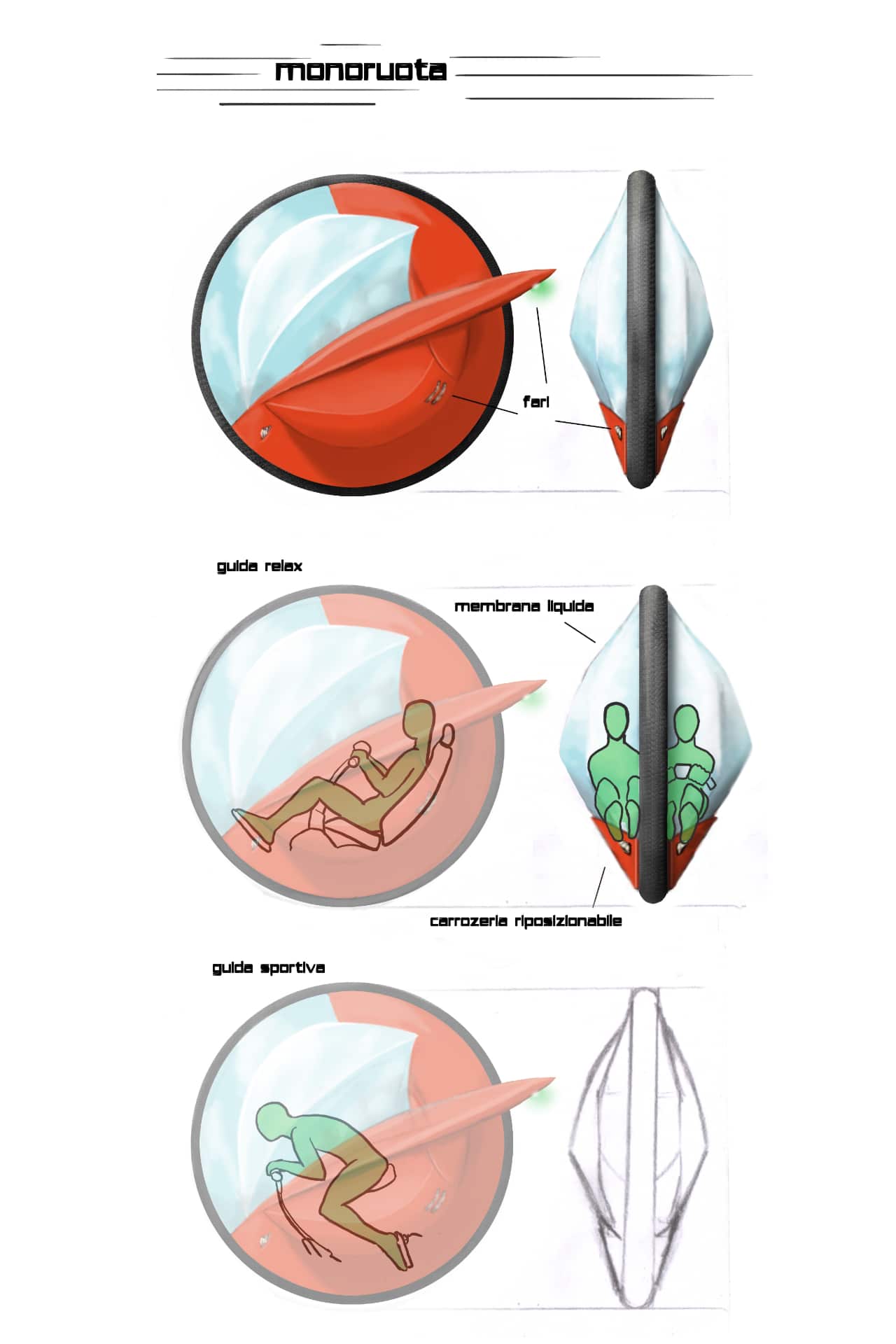
Improvvisamente un’altra monoruota si affiancò alla loro. – E questo chi è? Il pilota, il cui volto era nascosto da un casco integrale […]
Quando l’Ente iniziò a computare (…) la strategia migliore per raggiungere lo scopo prefissato, ne risultò che avrebbe dovuto muoversi con estrema circospezione. […]
(…) L’isola pareva allo stesso tempo elegante e non finita, come una scultura ancora in fase di creazione nello studio di un artista. […]
Era stata una buona giornata. Il branco stava tornando dal lungo giro nei territori di caccia, a nord-ovest dell’Isola di Capraia per poi puntare verso la Gorgona. […]
Protocollo di sicurezza per i Circuiti Nanoquasici – Versione 1.22 – A cura del Coordinamento Generale per le Ricerche di Frontiera – Oslo, 14 dicembre 2075 […]
(…) La terrazza era stata ottenuta tagliando via una grande parte del tetto dall’edificio principale ed era disposta su più livelli, in modo da permettere una visione (…) della volta celeste. […]
(…) Avrebbe potuto usare la sintesi vocale, il Muto, ma preferiva quello strano insieme di gesti, segni ideografici e disegni proiettati sulla retina dell’interlocutore […]
La stanza era apparentemente vuota. La luce e la disposizione geometrica delle pareti giocavano strani scherzi e parevano mutare angolazione e forma a seconda del punto di osservazione. […]
Il Massimo Comandante del Guojia Anquan Bu sorrise ironico, osservando allo specchio le numerose medaglie appuntate sulla sua giacca. Piccolo di statura e dai tratti squisitamente orientali, appariva molto anziano. […]
(…) Tacquero per diversi minuti, complice l’arrivo del tè. Fu servito da una coppia di anziani cinesi, con il cerimoniale GongFu Cha, come da disposizione del procuratore. […]
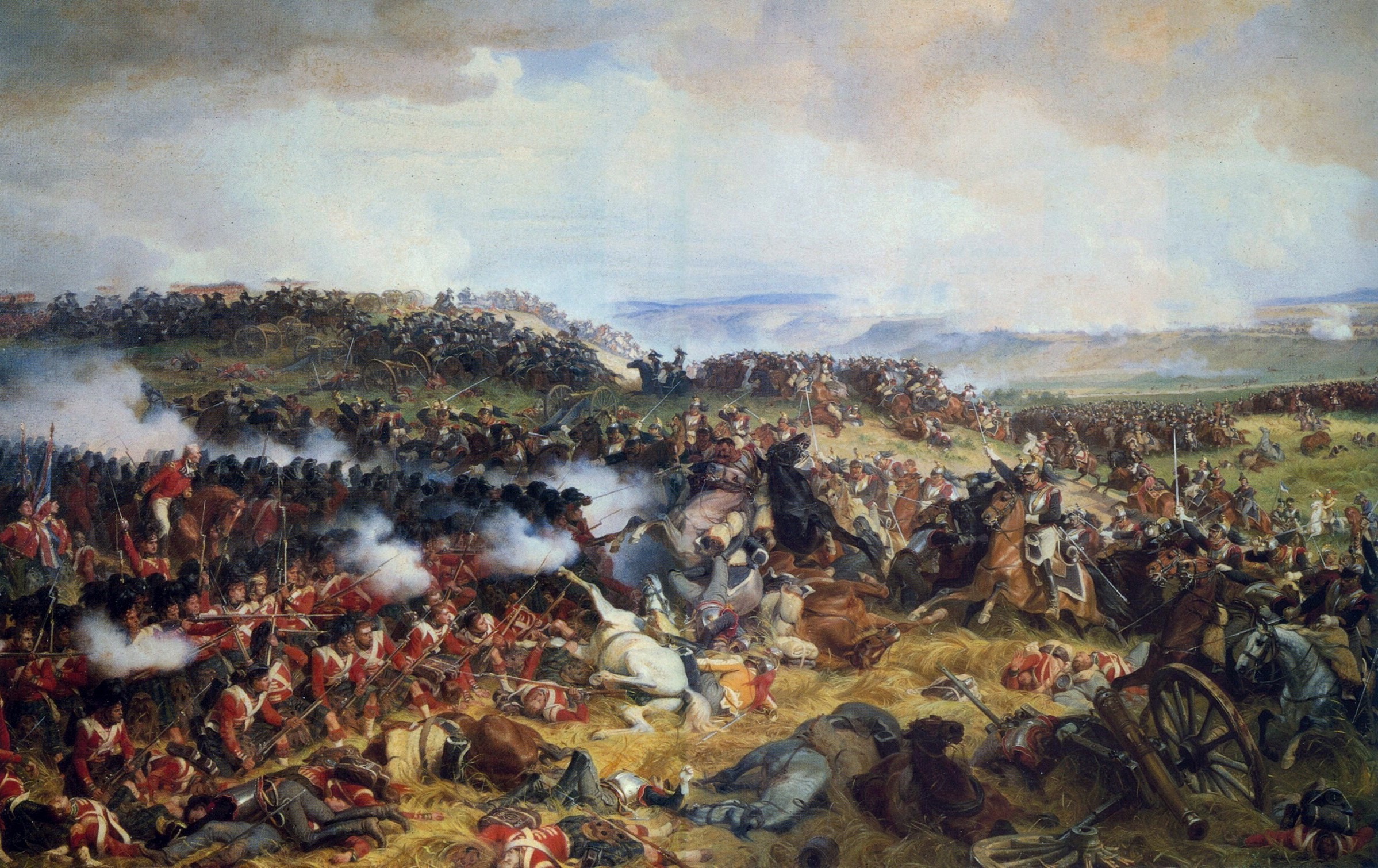
(…) Napoleone Bonaparte sedeva nella sua tenda da campo, cupo, in attesa del ritorno dei soldati inviati in perlustrazione. Non era riuscito a chiudere occhio, anche per il dolore sordo allo stomaco, tanto accentuatosi negli ultimi giorni. […]
(…) La ragazza danzava nel bosco, entrando e uscendo dai giochi di luci e ombre che il sole, alto nel cielo, creava fra i rami primaverili. Il cavaliere, nascosto dietro un grande cespuglio di mirto, la fissava tremando per la tensione. […]
(…) Mare.Tuffarsi nell’acqua tersa come cristallo, nuotare velocissimi qualche metro sotto, dove i raggi di luce sembrano danzare nello spazio di una cattedrale senza fine e senza fondo. […]
La villa, isolata al centro di un ampio podere, in parte coltivato a lino e cicoria e in parte coperto da un bosco di querce e olmi secolari, […]
(…) Il contatto con quel corpo delicato, morbido e sinuoso ebbe un effetto calmante su Matteo, che ricambiò l’abbraccio con una tenerezza che non gli era affatto abituale. (…)
Ma colui che arriva al principato col favore popolare, si trova a governare da solo, e intorno a sé non ha nessuno, o pochissimi, che non siano pronti a ubbidire. (…)
(…) Giaceva sul letto, supino, osservando la Via Lattea che ruotava lentamente sul soffitto e ascoltando in sottofondo l’adagio da ‘L’Autunno’ di Vivaldi. […]
(…) Nonostante il blando calmante che Carlo (…) era riuscito a farle assumere, la tensione in lei era ancora troppo alta per permetterle anche solo di pensare di andare a letto. […]
(…) – Ci siamo quasi. – Oltre a gestire la sua trappola, Jin era uno degli incaricati che avrebbero seguito la procedura, pronti a intervenire in caso di problemi. […]
L’Ente giaceva placido e sonnolento, non avendo alcun nemico naturale né alcun organismo in grado di concorrere nella Sua nicchia ecologica. Poteva quindi permettersi di oziare […]
Si alzò e si avvicinò alla lavagna interattiva, cancellandone la superficie con un gesto della mano, quindi si voltò verso gli altri. – L’idea di partenza è estremamente semplice. […]
Tutto accadeva in femtosecondi, lampi di pseudo.concetti espressi in proto.linguaggi si intrecciavano in strutture di sublime complessità.