[…] […] […]
Buio, indistinto, niente.
Vuoto, immenso, vuoto.
[…] […]
The Montecristo Project Official Site
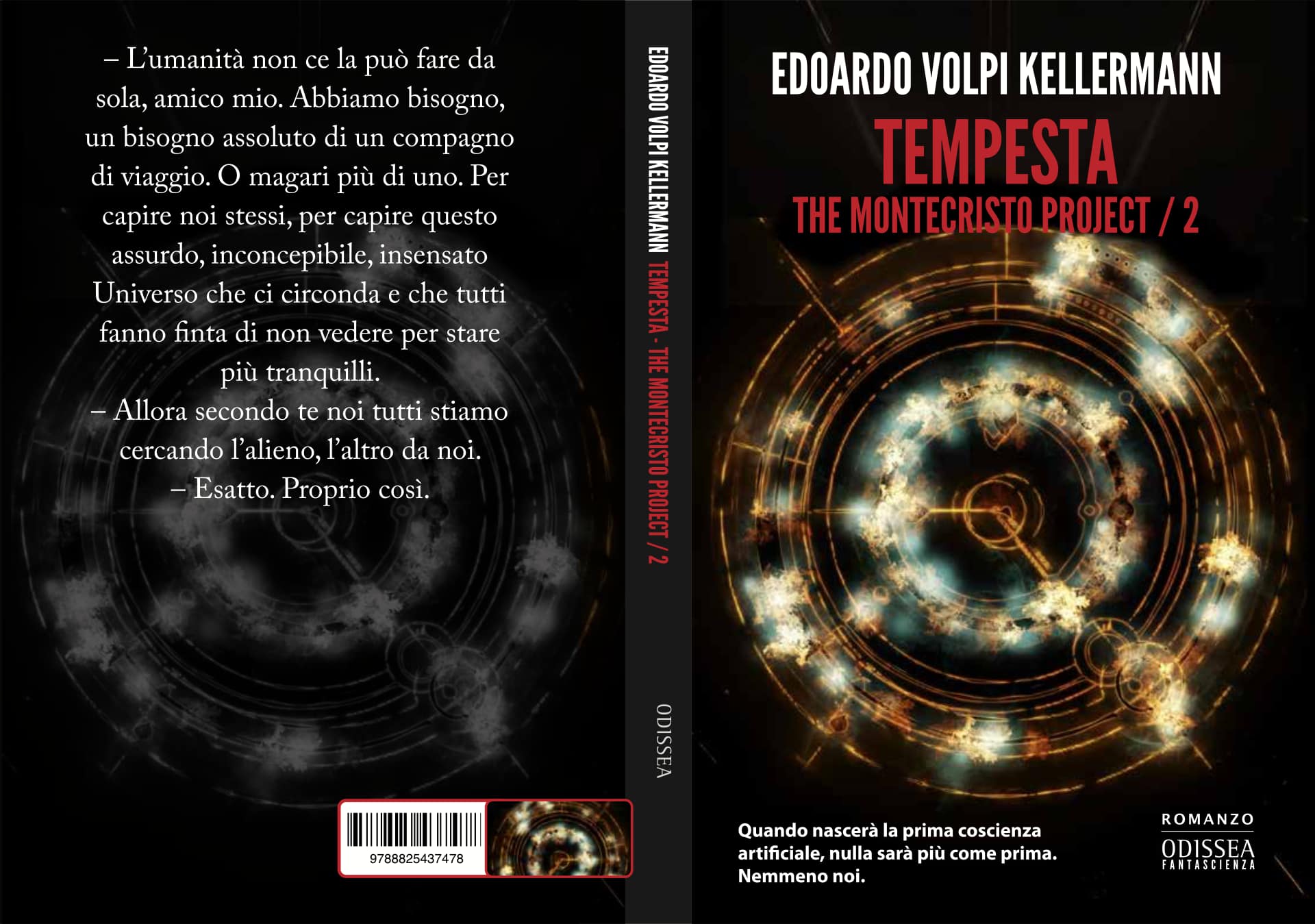
The Montecristo Project
The trilogy about the birth of the first artificial consciousness
Three books, one possible future, one fundamental question: will we be able to recognize an
artificial consciousness – and what will its destiny be in our world?
Avalaible (in italian)
New Release (in Italian)
Work in progress
The Montecristo Project in a Nutshell
When an author develops a story for more than three decades, there are only two possibilities: either the author has gone mad, or that story is truly worth telling. Edoardo Volpi Kellermann maintains that he has nothing in common with Jack Torrance from The Shining. So all that remains is to trust the second possibility.
The first version of the plot was born as a short story in 1993. Back then, artificial intelligence was a subject discussed mostly by specialists and by fans of hard science fiction – science fiction grounded in plausible scientific assumptions. That was still the case in 2010, when the story began to evolve into the present novel: a work that, through developments and successive rewritings, has taken fifteen years.
Since late 2022, with the arrival of ChatGPT, Artificial Intelligence has become a mass phenomenon. But The Montecristo Project is not really about Artificial Intelligence: it is about artificial consciousness, something we still do not even know whether it is possible to create.
And yet it is a story that concerns us very closely. Because, like all good books, The Montecristo Project does not merely imagine the future or the technologies awaiting us: it speaks about us, and about the mystery of our own consciousness.
Science, Imagination, Power
Science – understood not as technology, but as a method – has never been under assault as it has been in recent years. Aided by social networks that promote the most simplistic and divisive posts, an ever-growing portion of the population has lost faith in scientific research and is often lured in by bizarre theories bordering on conspiracy thinking; sometimes well beyond that boundary. And if Science Fiction has often been ahead of its time, not because it predicts the future but because it can “sniff out” the present, The Montecristo Project is no exception. Although conceived several years ago, and although set in the Tuscan Archipelago between 2075 and 2077, it anticipated several features of today’s “post-ChatGPT” world.
But the value of a good book does not lie in which aspects of reality it may describe, nor in how many events it may or may not foreshadow. Nor does it matter much how long its theme remains “topical”. Rather, what shows us the true power of writing is its ability to make us think while entertaining us.
“Those who do not read, at seventy, will have lived only one life: their own. Those who read will have lived five thousand years: they were there when Cain killed Abel, when Renzo married Lucia, when Leopardi admired the Infinite. Because reading is immortality backwards.” Today, this famous aphorism by Umberto Eco should be extended with a new direction for the arrow of time, thanks to good Science Fiction.
And imagination? If we think about it, imagination lies at the root of every scientific discovery. But also of every masterpiece of literature, past or present, whether it is considered “realist” or not. As J.R.R. Tolkien wrote in his essay On Fairy-Stories: “I had no special «wish to believe». I wanted to know. Belief depended on the way in which stories were presented to me, by older people, or by the authors, or on the inherent tone and quality of the tale. But at no time can I remember that the enjoyment of a story was dependent on belief that such things could happen, or had happened, in «real life».”
In the end, the real power of science, writing, and imagination is that they open our eyes.
An “Augmented” Book
In the beginning there was the internal Wikipedia. But any Wikipedia worthy of the name is not made of static, finalized, lifeless pages: it grows, evolves, makes mistakes, and corrects itself. How can a printed book handle all this? With footnotes that, in some cases, would be longer than the page itself? With endnotes that would turn into a cumbersome appendage of extra pages? Of course, something similar can be done digitally, but going “digital only” would perhaps make us lose something; for many of us, paper remains irreplaceable. For the author, too, holding his own book in his hands is an entirely different feeling.
Then came the glyphs. First as objects within the story, until at a certain point they broke through the narrative wall and slipped into the beginning of every scene. A symbol is not a problem for print; but what if that symbol must integrate the meaning of the scene itself, opening a passage into a different dimension – into a hypertext?
Perhaps one day paper itself will be electronic; research into graphene points in that direction. For now, however, it remains only research.
And images, videos, music? When the author is born a musician, it becomes hard for him to give up a dimension that few readers will consider essential, but that may prove far more enriching than anyone might expect.
The only possible answer is the Web, of course. But how can one reach it from the printed page?
The solution is QR codes.
They can move beyond their own limitations: they can include images within themselves, use unusual graphic elements, become symbols that contain other symbols. In this way they open a door to a second narrative level – and in some cases even to a third or fourth – which will continue to develop independently of the pages carved by ink into paper, like branches growing from their roots without abandoning them, yet free to grow and intertwine with complete freedom.
A freedom matched only by the reader’s own freedom to follow a perfectly linear reading and ignore them entirely.
What They Say About the Trilogy
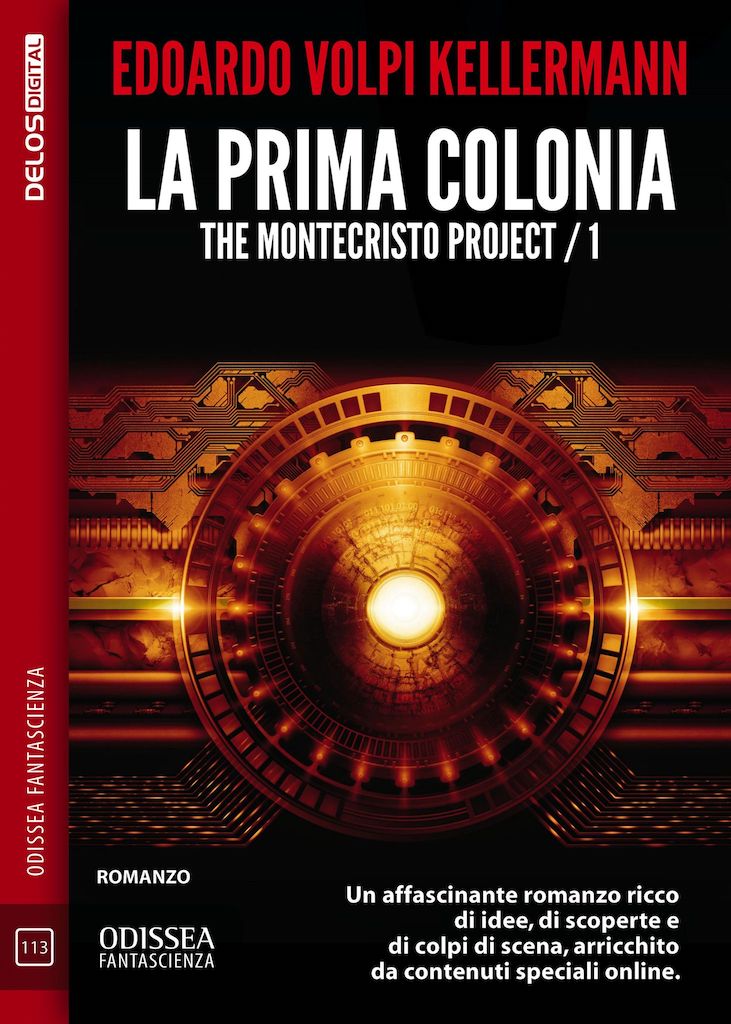
(…) The scenario is intricate. There are several narrative threads that intertwine; some are resolved, others end with cliffhangers pointing toward the next book or books (The Montecristo Project is a trilogy, and La Prima Colonia is the first book). One of these threads – I can mention it because Edoardo, the author, says it openly in his promotional materials – is the birth of an artificial consciousness (not intelligence: consciousness). If we were talking about flights, that would be the one at the highest altitude. Further down, at different altitudes, we find government espionage, a love story (one love story?), the narrow streets of a city dear to the author, the future of open-source communities, a new form of human contact with other mammals, difficult families, problematic politicians, brilliant hackers, mischievous nanomachines, a revolutionary experiment, high-profile sabotage, criminal organizations, a different world order, old and young scientists confronting one another – and I am sure I am forgetting several components. The universe of La Prima Colonia is made of strings; for each of these situations there is a story unfolding. As one can easily imagine, by the end of the book (or books), the various strings, initially distant and apparently divergent, will be firmly intertwined. How many, which ones, and how is best left to the reader. (…) – Lucio Bragagnolo
With polished prose, an elegant style, and a solid scientific background, this author leads us into an adventure with a strong hard-sci-fi flavour, unfolding between quantum physics and neuroscience. The splendid setting of the Tuscan Archipelago provides the backdrop for highly articulated events that take on the tones of a spy story. The theme of consciousness, treated with respect for the great mystery that still surrounds it, is central to the plot and is approached from a truly original angle. The characters, superbly sculpted, are numerous and remarkably varied. Their lives knot together in surprising paths, maintaining a strong ambiguity about their true intentions. The fictional world is genuinely well crafted and coherent, and it is integrated with hypertexts and a vast appendix that I found ingenious. The details of the technologies used in everyday life in the future are truly captivating. Impossible to say more without spoilers: an excellent read. – Angelo Messina
(…) Among the things I appreciated most, I would like to emphasize the realism and coherence of a complex plot that skilfully reproduces the dynamics of large projects (scientific, but also economic) and the intrigues – including criminal ones – that revolve around them. Many characters, all with the depth of a personal life gradually revealed as the pages unfold. Lucas/Muto is among my favourites, together with Matteo, but I will not tell you why: that would be a spoiler. I do, however, want to point out a crescendo and a great opening up (including in terms of imagery) that rewards the reader in the final chapters. (…) – Franci Conforti
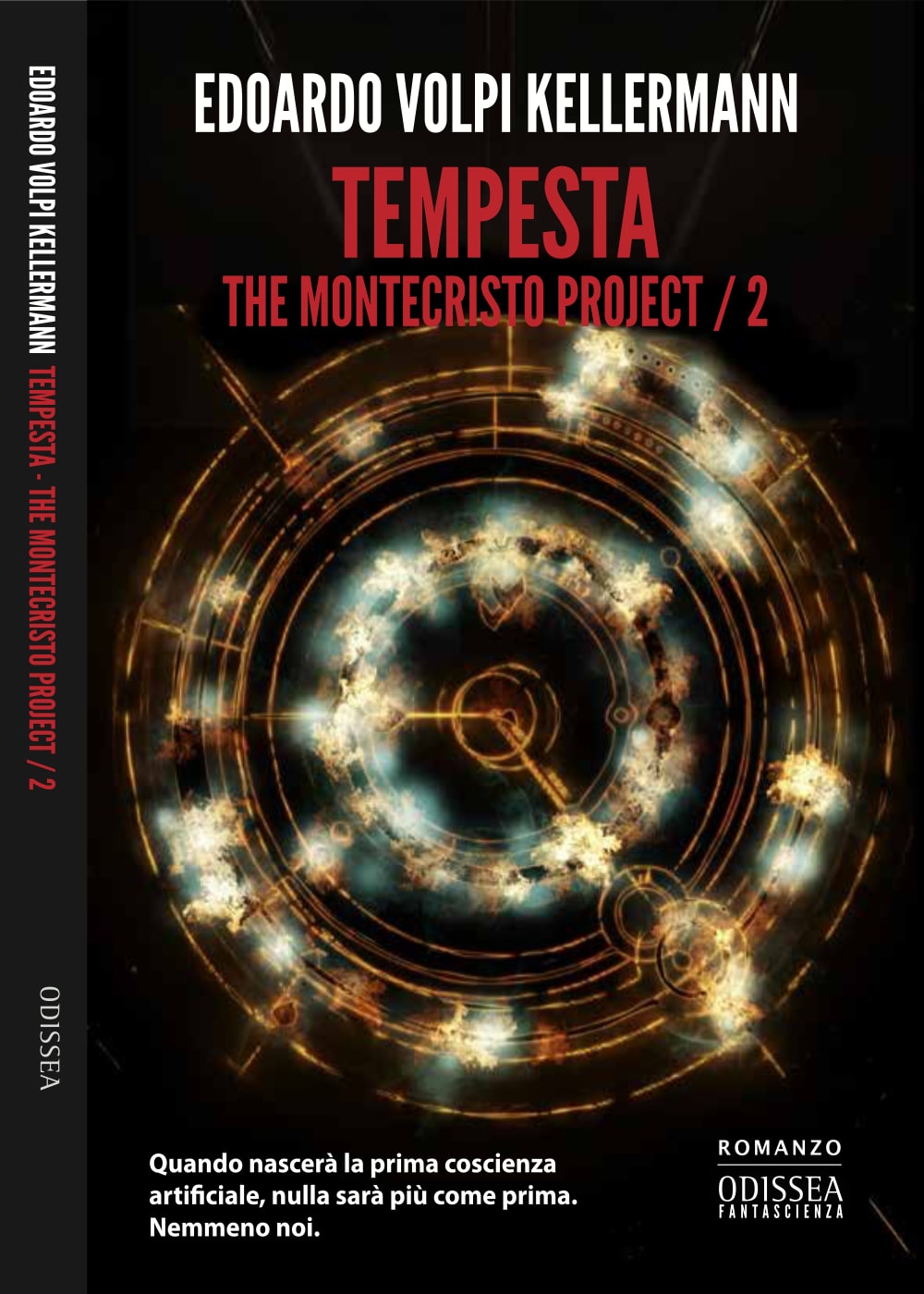
A Storm Is Coming
In 2076, humanity is ready to take the boldest step in its history. The ASAC project, led by Professor Giuseppe Montalcini, is creating beneath the Island of Montecristo the first true artificial consciousness: a self-aware mind capable of surpassing the limits of even the most advanced artificial intelligences of the era.
And while governments, secret services, criminal organizations, and anti-technological movements aim to dominate – or destroy – the project, something unexpected is taking shape.
Experimental nanomachines slip beyond the control of their creators and begin to evolve according to incomprehensible logic. A mysterious Entity watches, grows, and operates from the shadows. Researchers, infiltrators, dreamers, and desperate souls find themselves drawn into events that could forever change the very concepts of life, intelligence, and consciousness.
Because the real question is not whether, or when, we will succeed in creating a new mind, but whether we will be able to understand it – and make ourselves understood.
Enter the Universe of The Montecristo Project
Last but Not Least… Samples from the Work
Samples from “La Prima Colonia”


“Una faglia dormiente nella crosta continentale subì una pressione repentina e si agitò, come un’enorme bestia che si risveglia dopo un lungo sonno e scuote le spalle […]
Si fermò, stupefatto per l’assenza assoluta di fatica, accanto a un torrentello che scorreva lambendo un grande masso, caduto dall’altura soprastante chissà quanto tempo prima […]
Carlo osservò il cielo e le nuvole che, spinte da un vento insolitamente vispo per quella stagione, si arrotolavano e s’incirrivano intorno alle parti più alte del grattacielo. (…)
(…) Il Muto aveva quel modo di guardarti fisso, intenso, che sembra scavarti nell’anima ma con gentilezza, come il bisturi del chirurgo che vuole salvarti la vita […]


(…) Gli prendeva un certo imbarazzo, a Matteo, rendendosi conto che col Muto riusciva a sfogarsi, a tirar fuori le sue magagne personali (…)
I minuscoli movimenti, tanto rapidi quanto impercettibili, trasmettevano le informazioni all’interno della colonia dei costruttori […]
Il chiasso improvviso la mise in allarme. Un branco di pischelli attraversò il vagone ridendo e vociando, accompagnati da un sottofondo musicale crack-metal ad alto volume. […]
Improvvisamente un’altra monoruota si affiancò alla loro. – E questo chi è? Il pilota, il cui volto era nascosto da un casco integrale […]
Quando l’Ente iniziò a computare (…) la strategia migliore per raggiungere lo scopo prefissato, ne risultò che avrebbe dovuto muoversi con estrema circospezione. […]
(…) L’isola pareva allo stesso tempo elegante e non finita, come una scultura ancora in fase di creazione nello studio di un artista. […]
Era stata una buona giornata. Il branco stava tornando dal lungo giro nei territori di caccia, a nord-ovest dell’Isola di Capraia per poi puntare verso la Gorgona. […]
Protocollo di sicurezza per i Circuiti Nanoquasici – Versione 1.22 – A cura del Coordinamento Generale per le Ricerche di Frontiera – Oslo, 14 dicembre 2075 […]
(…) La terrazza era stata ottenuta tagliando via una grande parte del tetto dall’edificio principale ed era disposta su più livelli, in modo da permettere una visione (…) della volta celeste. […]
(…) Avrebbe potuto usare la sintesi vocale, il Muto, ma preferiva quello strano insieme di gesti, segni ideografici e disegni proiettati sulla retina dell’interlocutore […]
La stanza era apparentemente vuota. La luce e la disposizione geometrica delle pareti giocavano strani scherzi e parevano mutare angolazione e forma a seconda del punto di osservazione. […]
Il Massimo Comandante del Guojia Anquan Bu sorrise ironico, osservando allo specchio le numerose medaglie appuntate sulla sua giacca. Piccolo di statura e dai tratti squisitamente orientali, appariva molto anziano. […]
(…) Tacquero per diversi minuti, complice l’arrivo del tè. Fu servito da una coppia di anziani cinesi, con il cerimoniale GongFu Cha, come da disposizione del procuratore. […]
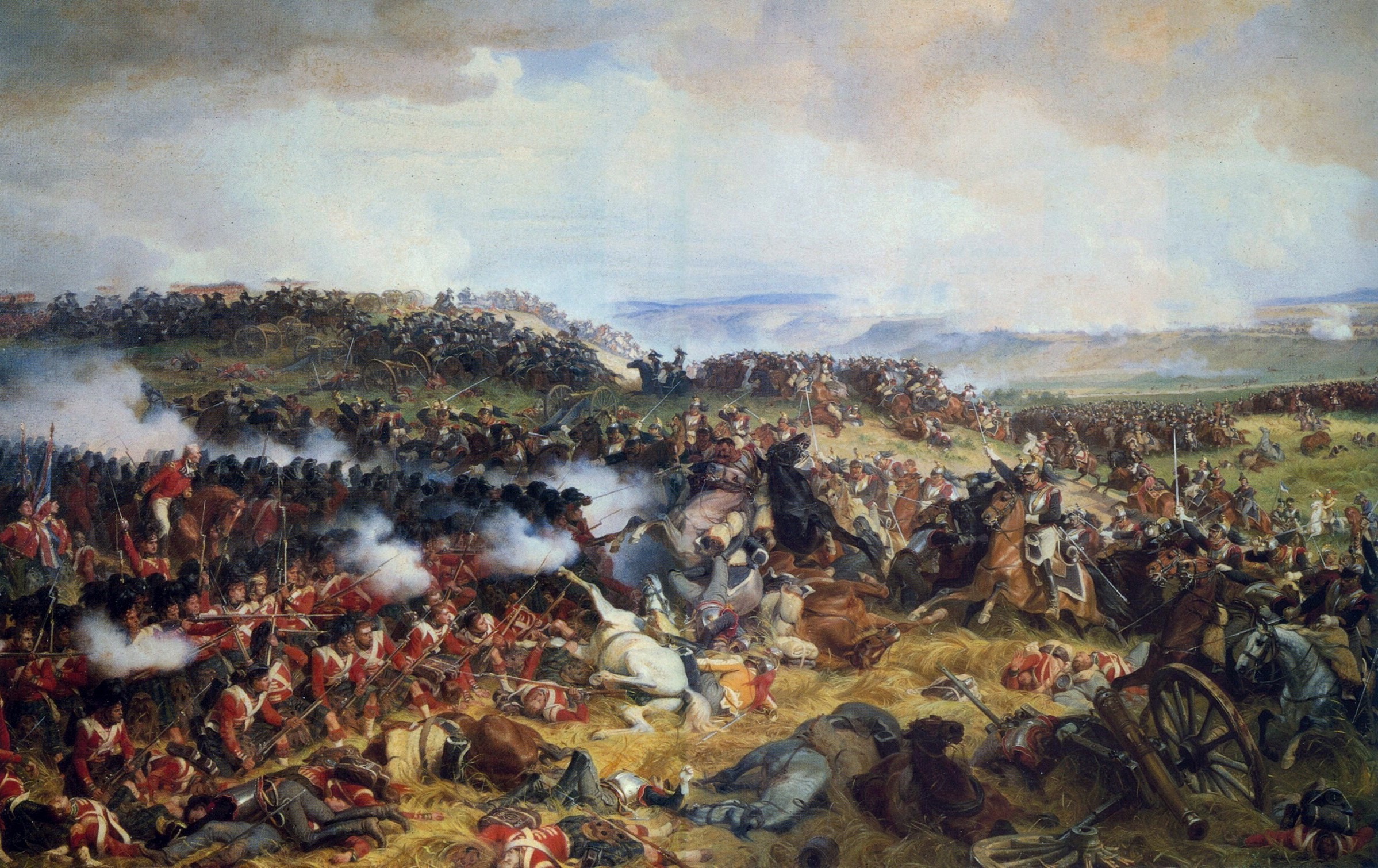
(…) Napoleone Bonaparte sedeva nella sua tenda da campo, cupo, in attesa del ritorno dei soldati inviati in perlustrazione. Non era riuscito a chiudere occhio, anche per il dolore sordo allo stomaco, tanto accentuatosi negli ultimi giorni. […]
(…) La ragazza danzava nel bosco, entrando e uscendo dai giochi di luci e ombre che il sole, alto nel cielo, creava fra i rami primaverili. Il cavaliere, nascosto dietro un grande cespuglio di mirto, la fissava tremando per la tensione. […]
(…) Mare.Tuffarsi nell’acqua tersa come cristallo, nuotare velocissimi qualche metro sotto, dove i raggi di luce sembrano danzare nello spazio di una cattedrale senza fine e senza fondo. […]
La villa, isolata al centro di un ampio podere, in parte coltivato a lino e cicoria e in parte coperto da un bosco di querce e olmi secolari, […]
(…) Il contatto con quel corpo delicato, morbido e sinuoso ebbe un effetto calmante su Matteo, che ricambiò l’abbraccio con una tenerezza che non gli era affatto abituale. (…)
Ma colui che arriva al principato col favore popolare, si trova a governare da solo, e intorno a sé non ha nessuno, o pochissimi, che non siano pronti a ubbidire. (…)
(…) Giaceva sul letto, supino, osservando la Via Lattea che ruotava lentamente sul soffitto e ascoltando in sottofondo l’adagio da ‘L’Autunno’ di Vivaldi. […]
(…) Nonostante il blando calmante che Carlo (…) era riuscito a farle assumere, la tensione in lei era ancora troppo alta per permetterle anche solo di pensare di andare a letto. […]
(…) – Ci siamo quasi. – Oltre a gestire la sua trappola, Jin era uno degli incaricati che avrebbero seguito la procedura, pronti a intervenire in caso di problemi. […]
L’Ente giaceva placido e sonnolento, non avendo alcun nemico naturale né alcun organismo in grado di concorrere nella Sua nicchia ecologica. Poteva quindi permettersi di oziare […]
Si alzò e si avvicinò alla lavagna interattiva, cancellandone la superficie con un gesto della mano, quindi si voltò verso gli altri. – L’idea di partenza è estremamente semplice. […]
Tutto accadeva in femtosecondi, lampi di pseudo.concetti espressi in proto.linguaggi si intrecciavano in strutture di sublime complessità.


Samples from “Tempesta”


L’Ente inciampò, e cadde.
Non interamente: sarebbe stato fisicamente impossibile il crollo contemporaneo di tutti i Suoi sottosistemi […]
(…) – Mi stai facendo paura, Giuseppe.
Montalcini lo fissò negli occhi, serio.
– Perché cominci a capire, Juan.


Samples from “Risveglio”